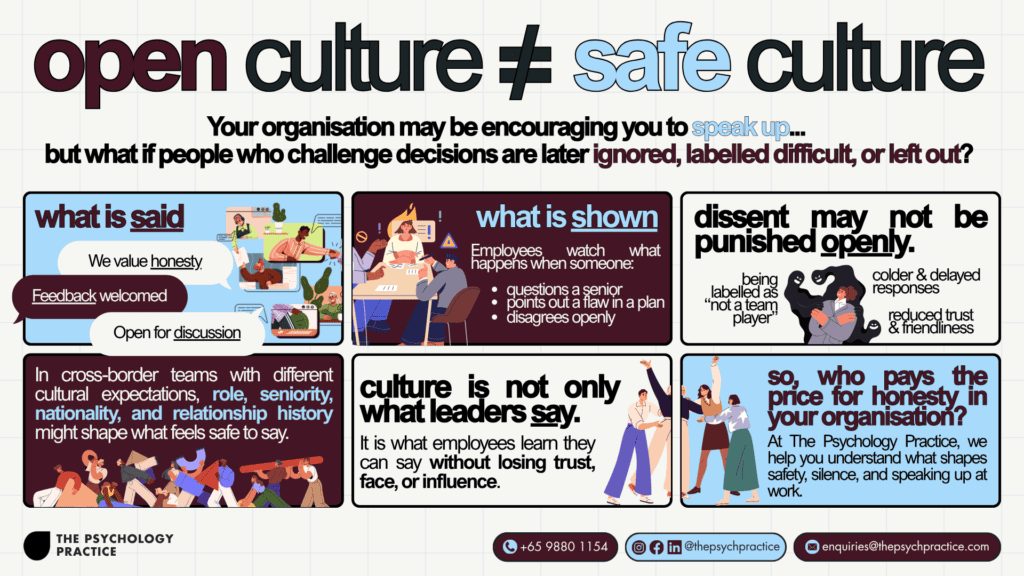
Many organisations only discover the limits of their “open culture” when someone says something inconvenient.
This is where psychological safety becomes less about communication style and more about consequence.
Employees are constantly reading the room: who can disagree, how directly, in front of whom, and what happens afterwards.In cross-border work, this becomes even more layered.
What looks like agreement may be careful diplomacy, and what sounds indirect may be an attempt to preserve working relationships while still signalling concern.
When leaders miss these cues, they may assume there is alignment when it is actually about caution.
A safe culture is not one where everyone speaks bluntly.
It is one where honesty can enter the room without costing someone their place in it.
Reach out to us, your needs are kept in mind. Nhu cầu của bạn luôn được ghi nhớ.